
Lansing Update: “MCC Event Highlights Resources for Pregnant Women, Moms, and Families” and more…
Posted May 20, 2021
MCC Event Highlights Resources for Pregnant Women, Moms, and Families
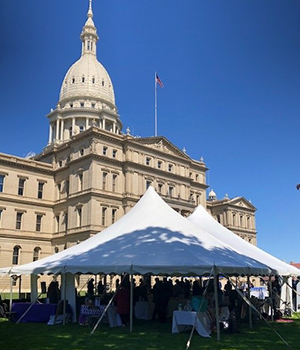
Michigan Catholic Conference (MCC) partnered with the Michigan Family Forum this week to host an event on the Capitol lawn called "Empowering Women, Strengthening Communities." The day connected community partners from around the state with their state lawmakers, highlighting the tremendous work carried out by pregnancy resource centers, maternity homes, and adoption agencies. The organizations explained the services they offer to assist pregnant women in need, new moms, and adoptive families. In total, twenty-five pregnancy resource centers, two maternity homes, and five adoption agencies came to Lansing to meet with lawmakers, primarily representing the southern portion of the lower peninsula. Catholic Charities West Michigan and Catholic Charities of Southeast Michigan were among those groups participating.
In conjunction with the event, the House Health Policy Committee included a presentation on pregnancy resources at its meeting (relevant content starts at 37:50 through the video). Representatives from a pregnancy center and a maternity home explained their services to the committee, while a representative from Catholic Charities West Michigan explained the agency's pregnancy help services and baby pantry, as well as their work with infant adoptions. House Resolution 104, sponsored by Representative Jack O'Malley (R-Lake Ann), was also passed by the Michigan House of Representatives. The resolution commended pregnancy care centers and established May 13th, 2021, as Pregnancy Resource Center Awareness Day.
Catholic Conference Again Urges Support for Driver's Licenses & I.D. Cards
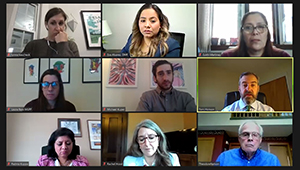
At a press event held online this week, Michigan Catholic Conference joined with a handful of advocacy organizations calling on lawmakers to support measures that would provide state identification cards and driver's licenses to undocumented immigrants and legal immigrants awaiting necessary documentation of their status. Citing the Catholic Church's overarching principle of upholding the human dignity of all people, MCC believes the driver's license policy is compassionate and makes common sense in terms of ensuring people and children can safely make their way to work, school, church, the grocery store, medical appointments and other activities that require transportation from one place to another. At the press conference, MCC shared:
"Denying individuals the ability to drive impacts their opportunity to work, to take care of children, to further an education, or assist a sick relative. Not only is this a matter of simple human dignity, it is also a safety issue: denying nearly 100,000 people the ability to obtain a driver's license increases the risk of auto accidents due to a lack of knowledge of the rules of the road."
Legislation referred to as "Drive SAFE" has been introduced in the form of Senate Bills 433 and 434, sponsored by Senators Stephanie Chang (D-Detroit) and Willie Brinks (D-Grand Rapids) and House Bills 4835 and 4836, sponsored by Representatives Padma Kuppa (D-Troy) and Rachel Hood (D-Grand Rapids). The Drive SAFE package would make specially designated noncommercial Michigan driver's licenses and state identification cards available to applicants who do not have proof of U.S. citizenship, but can prove their identity and Michigan residency. Together with the broader Church across the country, MCC has supported a driver's license policy for undocumented persons over several legislative sessions, since 2008 when Michigan's current policy was enacted. Failed efforts to reform the nation's immigration problems have resulted in patchwork approaches by states, whereas, according to the U.S. Conference of Catholic Bishops, comprehensive immigration reform is necessary to ensure the reunification of families, to move people into permanent residency status, and to promote the universal notion of human dignity that is not reliant upon a person's legal classification.
Hyde Amendment in Jeopardy; Pro-Life Support Needed
For the past forty-five years, a federal policy called the Hyde Amendment has prohibited federal funding for elective abortions. All this time, Hyde and similar provisions have enjoyed wide, bipartisan support among lawmakers and the general public. In fact, the Hyde Amendment has been signed into law every year since 1976, regardless of whether Congress and the White House were controlled by Republicans or Democrats. Unfortunately, the status of these life-saving amendments are currently in jeopardy, as powerful elected officials have called for their elimination. It is critical that pro-lifers send a strong message to Congress: our taxpayer dollars should NOT pay for abortion.
The Hyde Amendment and others are renewed annually in federal budget bills. During current negotiations, the U.S. Conference of Catholic Bishops have called on American Catholics to take widespread action in the first week of June, by signing a petition for members of Congress in support of the Hyde Amendment and similar laws. MCC urges members to consider the following actions:
- Take a few minutes to sign the petition at www.NoTaxpayerAbortion.com.
- Use the related resources-including flyers, fact sheets, and graphics at www.respectlife.org/no-taxpayer-abortion-to promote the campaign widely within your parish and community, by or on the first weekend of June.
Supplemental Budget Includes Critical COVID-Aid for Nonpublic Schools
This week, the Michigan House of Representatives approved a supplemental budget bill for the current fiscal year (which ends on September 30, 2021) by a 96-10 vote. The measure does currently include federal COVID-19 aid for nonpublic schools, the Emergency Assistance to Nonpublic Schools Program. EANS funding would cover expenses such as supplies for sanitation, personal protection equipment, and technology upgrades to enable remote learning. Although the money was awarded to the state by the federal government, the Michigan Legislature is required to appropriate the funds through a budget bill in order for them to be disbursed.
The House supplemental included almost $87 million in EANS aid that was approved by Congress in December. It also includes an additional $93 million in new EANS funding that was passed and signed into federal law in March 2021. Next in the process, the Senate must approve its version (previously passed by the Senate Appropriations Committee) or the House bill and then send the supplemental to Governor Whitmer for her signature. MCC will continue to advocate for a swift resolution for the benefit of Michigan students and school staff.
House and Senate Pass State Budgets: A Review of Education Items
Throughout the past several months, members of the Michigan Legislature have been working on developing and approving their state budget proposals for the upcoming October 2021-September 2022 year. This week, the Michigan House of Representatives and Senate each approved their respective budget bills, which included the following education items of interest to MCC:
- Competitive Robotics Grant Funding for Nonpublic Schools: While the governor did not include this item, the House provides $600,000 and the Senate provides $300,000 for this item, which would assist schools with competition fees and stipends for coaches, among other expenses. It has been funded in previous years.
- Nonpublic School Mandates: The House provides $2.5 million to reimburse nonpublic schools for costs associated with meeting State health, safety, and welfare requirements for students. The Senate provides $250,000 for this purpose, while the governor did not include it in her proposal. If funding is approved, it would be available in addition to funds appropriated in prior years and held in escrow due to litigation.
- School Safety Grants: The House provides $2.5 million for nonpublic schools and $7.5 million for public schools, to offer a competitive grant program for school safety projects. Neither the Senate nor the governor's proposal includes safety grants.
- Tuition Grant and Tuition Incentive Programs: The governor, House, and Senate agree to maintain current funding of $42 million for the Tuition Grant Program, while the House and Senate provide $2.5 million additional funding for the Tuition Incentive Program, with total funding at $71.3 million. These programs help low-income students attend college.
- Dual Enrollment: The governor, House, and Senate propose increasing dual enrollment by $167,000 to $2.3 million for nonpublic students enrolled in college courses.
House and Senate Pass State Budgets: A Review of Departmental Items
The House and Senate budget bills that passed each respective chamber this week also contained several non-education related items that MCC has been advocating for throughout the process. Those include:
- Pregnancy and Parenting Student Support Services: The House and Senate provide $500,000 and $148,600, respectively, to fund campus offices assisting pregnant and parenting students.
- Abortion Counseling: The governor removed previous School Aid budget language from her proposal that required school districts to have a disciplinary policy for staff who refer students for abortion. The House returned the language to the budget, while the Senate did not.
- Reporting Requirements: The House and Senate both reinstated budget language that requires universities conducting research using human embryonic stem cells to report to the Department of Health and Human Services regarding compliance with federal guidelines.
- Pregnancy-Related Services: The House provide $700,000 to restart the previous pregnancy and parenting support services program, $10 million for a marketing program to promote infant adoption as an alternative to abortion, and $1.5 million for pregnancy resource center grants. The Senate provided a placeholder to continue consideration of funding grants for Pregnancy Resource Centers and also allocated $250,000 for Diaper Bank Assistance Grants. None of these items were in the governor's recommendations.
- Private Foster Care Administrative Rates: The Governor and the Senate retain the current rate of not less than $46.20 per day. The House provides a $9 per diem rate increase to $55.20. The House also includes $50,000 for a Foster Care Closet program.
- Human Trafficking Intervention Services: The Governor and House and Senate include $200,000 for human trafficking intervention services. Both the House and Senate proposals provide language that the Department of Health and Human Services collaborate with schools on training for students regarding human trafficking and sexual abuse prevention. Additionally, the House version provides $500,000 one-time funding for a human trafficking victim services expansion pilot program, and it allows individuals who are victims of domestic violence or human trafficking to receive additional 3 months on food assistance.
- Abortion Contract and Grant Language: Despite the governor's removal of the language, both the House and Senate reinserted budget language which reiterate the state's policies to not contract with or provide grants to organizations which provide elective abortions, and to not use state funds for abortion counseling, referrals, or services.
- Children's Clothing Allowance: The Governor, House, and Senate all maintain the annual clothing allowance for all eligible children in the Family Independence Program.
- Raise the Age: The Governor and House provide $29.1 million to implement Raise the Age polices and help seventeen-year-olds in the criminal justice system receive age-appropriate rehabilitative services. The Senate provides $12.1 million to phase in the implementation.
- Behavioral Health Access: While the governor included $91 million to improve access to and consistency of behavioral health for Medicaid enrollees and those served through the child welfare system, the Senate allocated half of this amount. The House provided placeholder funding to allow conversations to continue about the funding, while also ensuring substantive changes are made to reform the mental health system.
- Homeless Services: The governor, House, and Senate all agree to maintain funding for emergency shelters, homeless programs, and runaway youth grants.
- Senior Service Programs: The Governor, House, and Senate all agree with maintaining funding of senior services programs, with the House also continuing one-time funding of $150,000 for small grants for health-related senior programs at multipurpose senior citizen centers.
- Telemedicine Services: The Senate has included new language, not included in the governor or House proposals, to require the same level of reimbursement for services provided through telemedicine as for services provided through face-to-face contact in the Medicaid program, and to encourage telehealth for children's special health care services.
MCC Testifies on Behalf of Consumer Protections in Payday Lending Industry
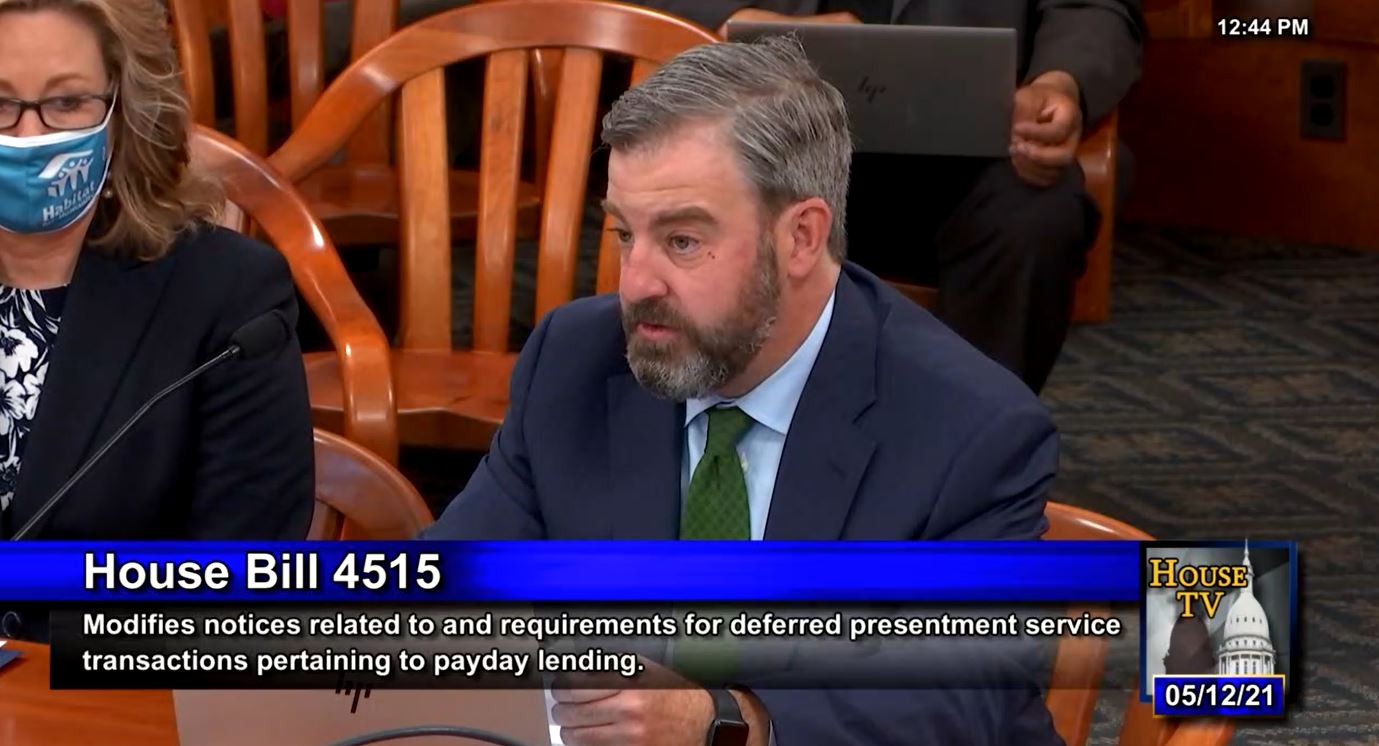
On Wednesday, May 12, Michigan Catholic Conference testified alongside Habitat for Humanity of Michigan in the House Financial Services Committee, speaking to the need for legislation that protects individuals who are seeking high-risk, short-term loans (known as payday loans). More specifically, House Bill 4515 would establish a 30-day cooling-off period for those who take out payday loans and institute "ability to repay" considerations. Such provisions would help protect those struggling with financial hardship from falling further into debt. Staff also supported House Bill 4828, which would require the Department of Insurance and Financial Services to submit yearly reports on payday loans, collecting data such as who uses them, how often, fee amounts, and more. The reports would be required for 7 years and would both be sent to the Michigan Legislature and posted on the Department's website. Both bills, which are sponsored by Representatives William Sowerby (D-Clinton Twp.) and Cara Clemente (D-Lincoln Park), await further consideration in the House Financial Services Committee.