Catholic Advocacy Delivers Support for Families

While the amount of legislative activity at the State Capitol may fluctuate, there is one constitutional duty the Michigan Legislature must complete each year: the annual state budget.

Spanning hundreds of pages, detailing more than $80 billion in public spending, and containing bureaucratic program names, the state budget may appear irrelevant and unwieldy to the average person.

But in reality, the budget contains a series of decisions that impact the lives of all Michigan residents. A government budget ultimately serves as a moral statement that indicates the priorities public officials support with taxpayer dollars.

As the public policy voice for the Catholic Church in this state, Michigan Catholic Conference each year analyzes the state budget and monitors the legislative appropriations process. MCC advocates for funding that aligns with its mission to promote human dignity and serve the common good. This advocacy may include meeting with key lawmakers in both chambers and parties, collaborating with other advocacy organizations, and activating grassroots advocacy through MCC’s Catholic Advocacy Network.

The budget, by providing a plan to spend public tax resources, affects all individuals. It should follow that the state budget then must be a document that serves the public interest. MCC, as the voice of the Church and inspired by the example and teaching of Jesus Christ, consistently advocates for spending programs that help individuals in need.

This edition of Focus shares stories about state budget programs that support individuals in need, as well as MCC’s advocacy to secure funding for these programs that help parents and children, homeless and runaway youth, and foster and adoptive families. 

Top left: Stephanie Busch, pregnancy and parenting program manager for Catholic Charities West Michigan (CCWM), oversaw the agency's mobile diaper bank initiative, which was funded by state dollars MCC advocated for including in the state budget. Credit: CCWM. Top right: Case managers representing The Ark interact with a client. The Ark is an outreach program offered by Catholic Charities for the Diocese of Kalamazoo (CCDOK) for homeless or runaway youth. Credit: CCDOK.
Distributing diapers—and hope—to those who need it most

How MCC advocacy helped spur a Catholic-run mobile diaper bank to serve rural Michigan families

Diapers are among the many non-negotiable staples that come with raising children. But if family finances are strained—including from the many expenses associated with childbirth—it may be difficult for some parents to afford necessities.

Many Michigan families face challenges in meeting their needs, such as diapers for their children. That was made evident when one Catholic agency distributed 1.2 million diapers to families in need across nine Michigan counties over two years, which was made possible through a state-funded grant.

The grant funding was the catalyst for the mobile diaper bank initiative run by Catholic Charities West Michigan (CCWM), the Church’s social services provider within the Diocese of Grand Rapids. Michigan Catholic Conference successfully advocated to expand the grant in the state budget to include more organizations that distribute diapers for free.

Given the amount of diapers distributed over the 10,000 recorded visits to the mobile units, the CCWM diaper bank proved a crucial resource for families in need.

“A lot of times they were coming, and you would hear, ‘I’m on my last diaper,’” said Stephanie Busch, pregnancy and parenting program manager for CCWM, who oversaw the mobile diaper bank initiative.

But with any Church initiative to serve others in need, it is not only about meeting the physical needs of individuals.

“As soon as they receive those supplies, you see the smile on their faces, you see some of that stress just leave their body, which is a pretty wonderful thing,” said Mike Voyt, the hunger prevention and children services director for True North Community Services, one of the local agencies that partnered with CCWM for the diaper distribution.

CCWM Mobile Diaper Bank by the Numbers

From 2023 to 2025, Catholic Charities West Michigan (CCWM) operated a mobile diaper bank to serve families in the Diocese of Grand Rapids. The diapers were funded through a state grant that Michigan Catholic Conference advocated for including in the state budget. Here’s a look at the impact of the CCWM-led initiative.

1,275,000

Estimated diapers distributed to individuals who visited CCWM’s mobile diaper bank over two years.

10,687

Visits made by families to CCWM’s mobile diaper bank over two years.

9

Counties served through the CCWM mobile diaper bank.

Beginning in 2025, CCWM used the state diaper funding to purchase diapers for distribution from the Muskegon location of its St. Gianna’s No Cost Baby Boutique, which provides free baby supplies and services for parents. During that year, an estimated 168,000 diapers were distributed across 2,093 visits.

‘It was obviously a need’

CCWM was invited to assist in the distribution of diapers funded by the Michigan Diaper Assistance Program, the grant included by lawmakers in the state budget.

The Catholic charity was tasked with reaching individuals across nine counties in rural west Michigan. With such a large area to cover, rather than expecting people to come to them, the agency brought the diapers to the people.

“We knew sometimes in rural areas it was hard … you might only get one ride into town in a month,” Busch said.

CCWM initiated a mobile diaper bank to serve rural west Michigan families in need. Credit: CCWM

CCWM initiated a mobile diaper bank to serve rural west Michigan families in need. Credit: CCWM

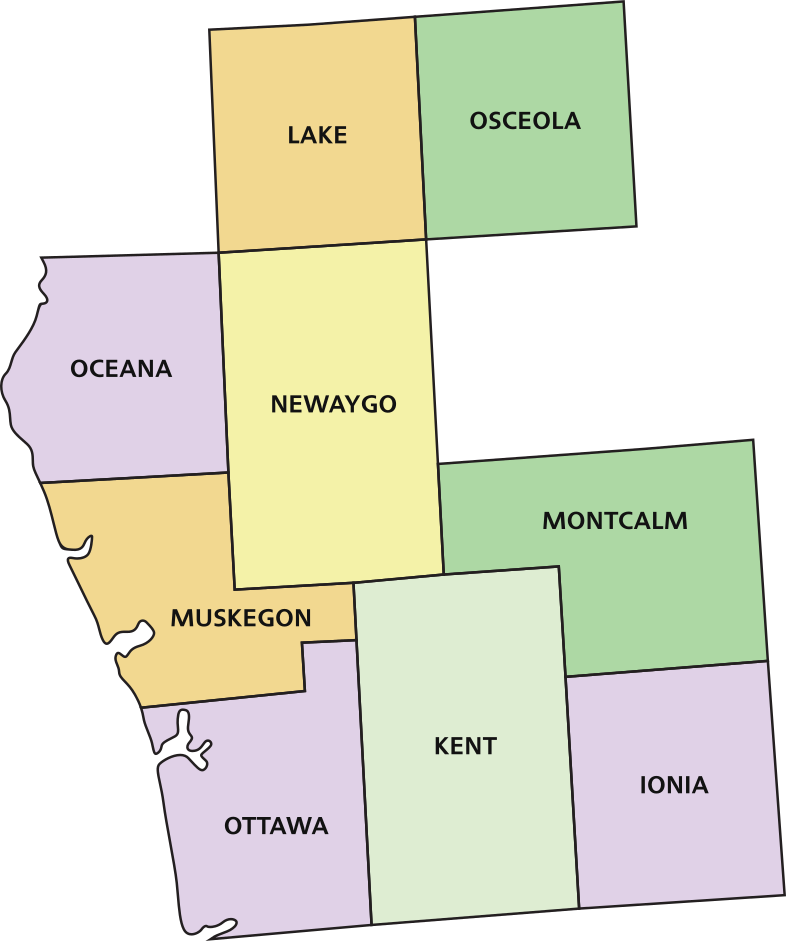
With vans packed with 110 cases of diapers, CCWM staff traveled to the far northern reaches of the diocese, such as Osceola, Newaygo, Oceana, and Lake counties, and set up near local food pantries and other places where individuals received assistance.

These counties are among the more economically disadvantaged in the state, having fewer community resources available for families in need, Busch said.

“We always ran out of diapers,” she said. “We would go through the entire van. It was obviously a need, and it was something people were willing to come out for.”

MCC advocacy broadens reach of state diaper grants

The state diaper grant program began as a $250,000 item for diaper banks included in the 2022 state budget. In its monitoring of the budget for spending items of interest to the Church, MCC noted the diaper program and reached out to multiple key lawmakers who make decisions on funding.

As a result of those meetings, MCC successfully advocated for expanding the grant in the budget to include nonprofit agencies that distribute diapers for free, along with diaper assistance programs, maternity homes, and local county offices.

Lawmakers increased funding for the expanded program to $4.4 million in both 2023 and 2024, and then to $6.4 million in both 2025 and 2026, providing more dollars to flow to more organizations helping families obtain these necessities.

MCC has annually reiterated its support for the program, including to the chairs of the legislative committees that oversee budget spending.

From diapers to other services that help parents in need

For CCWM—one of many organizations that distribute the state-funded diapers—the agency reported handing out 950,000 diapers across nine counties in 2023, and 325,000 diapers in five counties the following year.

The mobile diaper initiative was paused due to limitations on the funding that made it difficult to operate in the same manner as before. However, the same state funding stream continues to benefit families in need, as CCWM used it to pay for the 168,000 diapers distributed through the agency’s No Cost Baby Boutique in Muskegon during 2025.

The St. Gianna's No Cost Baby Boutique, run by CCWM with locations in Grand Rapids and Muskegon, aims to empower families through compassionate care and a dignified shopping experience. Credit: CCWM

The St. Gianna's No Cost Baby Boutique, run by CCWM with locations in Grand Rapids and Muskegon, aims to empower families through compassionate care and a dignified shopping experience. Credit: CCWM

The CCWM initiative named after St. Gianna Molla (see below) aims to empower families through compassionate care and a dignified shopping experience. The boutique setting allows CCWM to build relationships with parents and help them in other ways.

“Diapers are what gets people in the door,” Busch said, adding that, “our hope is that from there, they're going to be able to have a more enriched experience” by working with staff to help address other issues parents may be facing—access to employment, housing, or education, for instance.

CCWM operates St. Gianna’s locations in Grand Rapids and Muskegon and is planning to open a third location around Mecosta and Osceola counties—the same rural counties that benefited from the mobile diaper bank.

“We were approached about opening a Gianna’s up there, because the community just felt like there’s nowhere to go,” Busch said.

‘It’s about giving them that hope’

The state diaper grant program, at $6.4 million in annual spending, represents just a tiny sliver of the $80 billion state budget, and CCWM is just one agency in one corner of the state that has used the funding to help others.

But whether through the diapers offered at CCWM’s baby boutiques, or the diapers distributed during the mobile diaper bank, something as simple as a pack of diapers means more to those who receive them.

“It seems like just diapers,” Busch said. “But sometimes it's about giving them that hope, that there are people out here who care about me.” 

Who is St. Gianna Molla?

St. Ginna Molla

St. Gianna’s No Cost Baby Boutique is named for St. Gianna Molla of Italy, a patron saint of mothers who also was a doctor, wife, and mother of four. She is best known for when, during her fourth pregnancy, she chose to have a tumor removed from her uterus to preserve the life of her child, rejecting two other options that would have ended her baby’s life. St. Gianna later gave birth but died shortly after due to complications. Her daughter born from that final pregnancy, Gianna Emanuela Molla, is now herself a doctor and travels the world speaking about her mother’s heroic courage. St. Gianna, who died in 1962, was canonized in 2004 by Pope St. John Paul II, and her feast day is April 28.

It takes a village to foster or adopt a child

How MCC advocacy supports Catholic Charities services for foster and adopting families

Any parent understands why it takes a village to raise a child. For parents of foster and adopted children, that village may include their local Catholic Charities agency, some of which facilitate child welfare cases in Michigan on behalf of the state.

One foster mother said the caseworkers of Catholic Charities of Ingham, Eaton & Clinton Counties (CCIEC) in mid-Michigan provided the support she and her husband needed as they fostered six children and permanently adopted three.

“They’ve walked beside us every step of the way—offering resources, encouragement, and understanding whenever we needed it,” the foster mother said, whose story was shared by CCIEC. “The staff is not only helpful and knowledgeable, but also genuinely kind and caring.”

In delegating some child welfare cases to private agencies, the state of Michigan provides funding based on the number of children the agency is caring for at any given time. The funding rate—determined on a per-child, per-diem basis—is set each year in the state budget.

MCC monitors and advocates for adequate funding for the foster care administrative rate each year in the state budget in support of Catholic Charities agencies that care for vulnerable children in need of foster care and adoption.

“It’s the bulk of the money that the agency receives” for child welfare services, said Kristie Hardin, director of child welfare for Catholic Charities of Southeast Michigan (CCSEM), regarding the foster care administrative rate. CCSEM facilitates adoptions and foster care services in the Archdiocese of Detroit.

The funding ensures agencies can physically operate, but the deeper impact comes through the services that caseworkers provide families and children (see below).

“Fostering can be both joyful and challenging, but knowing we had a strong, supportive team behind us made all the difference,” the foster mother who worked with CCIEC said.

Without that strong team in place at Catholic Charities agencies—backed by the state foster care rate—it would be more difficult for families to navigate the process successfully. Making that process work smoothly is important, as every successful outcome or placement is an opportunity for a better life for the child.

“Foster children are just like any other child … they deserve to have a childhood,” Hardin said. 

How do Catholic Charities help foster and adopting families?

MCC advocates for state funding that supports the child welfare services Catholic Charities agencies provide to foster care or adoptive parents. Here are just some of the services that Catholic agencies assist parents with:

Pre-placement support

  • Coordination of and interviews for home study
  • Enrollment into trainingPreparation for matching and placement

Ongoing case management

  • Home visits on a minimum monthly basis
  • Around the clock on-call emergency support
  • Coordination of services for children placed in the home
  • Family visit coordination and monitoring
  • Court representation and communication
  • Support around reunification and permanency planning
  • Help navigating Medicaid and health insurance

Child-specific support

  • Medical, dental and mental health appointment coordination
  • Referrals for therapy or specialized services
  • Education monitoring and support
  • Meeting coordination related to Individualized Education Plans (IEPs) and 504 plans
  • Behavioral support planning and interventions
  • Monitoring of medication
  • Emergency placement coordination

Training

  • Policy and procedure updates
  • Behavior management techniques
  • Cultural education

A refuge for youth in crisis

How one Catholic agency helps homeless and runaway youth in southwest Michigan

After two years of homelessness, sisters Sophia and Audrey and their mother said finally having their own apartment was the best Christmas gift they could have ever received.

Evicted from their mobile home and trying to escape from ongoing domestic violence, the family’s cycle of moving from motel to motel and shelter to shelter ended thanks to help received from Catholic Charities for the Diocese of Kalamazoo (CCDOK) and its Ark initiative.

The Ark refers to the services CCDOK offers to homeless or runaway youth and their families to provide support and stability. The program—which includes the operation of a shelter and transitional housing, as well as case managers who work with families—has been run by CCDOK in one form or another for decades.

The Ark is supported through an annual appropriation in the state budget that funds services for homeless and runaway youth. The Ark is a critical provider of services to youth in crisis in southwest Michigan, said Toni Newell, executive director of CCDOK.

The Ark shelter is open 24 hours a day and seven days a week in Kalamazoo, and CCDOK operates drop-in centers in each of the nine counties it provides youth services. Kids can stay for up to 21 days and receive individual case management, counseling, and medical care. When officially admitted into the program, youth and their family and staff develop individualized plans to address the crisis that brought the youth there.

Case managers representing The Ark interact with a client. The Ark is an outreach program offered by Catholic Charities for the Diocese of Kalamazoo (CCDOK) for homeless or runaway youth. Credit: CCDOK

Case managers representing The Ark interact with a client. The Ark is an outreach program offered by Catholic Charities for the Diocese of Kalamazoo (CCDOK) for homeless or runaway youth. Credit: CCDOK

Without the availability of shelter and services, homeless youth or those who have run away could more easily find themselves susceptible to trafficking or crime, Newell said.

MCC will advocate for CCDOK’s Ark program during the budget process to continue these important services for youth. MCC has also supported the Ark through advocacy on legislation that would have removed barriers for shelters like the Ark that provide emergency youth services.

When Sophia, Audrey, and their mother came to the Ark, case managers worked with local partners to get the family set up in safe and stable housing. In addition to securing donated clothing, kitchen supplies, bedding, and other essentials for their new home, Ark staff assisted in getting the girls enrolled in school and referred the mother to counseling to support her healing from domestic abuse.

Based on their testimony shared with CCDOK and provided to MCC, finally having a home to call their own resonated with the family that had been on the run for two years.

“The family shared how grateful they were and said this was the most beautiful apartment they had ever lived in—because it was all theirs,” according to their testimony provided by the Ark.